

Most people assume a house fire means the house is done. That’s rarely true. Fire damage covers an enormous range, from a scorched wall in one room to a structure that needs to be rebuilt from the ground up, and where your property actually falls on that range is what determines whether you’re looking at a repair, an as-is sale, or something else entirely.
You can sell a fire-damaged house in Edmonton. If you’re trying to sell a fire damaged house in Edmonton, this guide walks you through how to figure out where your damage actually sits, what that means for value and for your options, and what the practical next steps look like from here.
Can You Sell a Fire-Damaged House in Edmonton?
Yes, and severity is really the question underneath the question. If you’re looking to sell a fire damaged house in Edmonton, a single scorched room and a structural loss aren’t the same conversation, even though both get called “fire damage.” The section below walks through that range directly, since where your property lands on it shapes almost everything else in this guide.

Where Does Your Fire Fall on the Severity Range?
This is often the more useful question to ask before getting into repair-versus-sell decisions, since fire damage covers an unusually wide range, wider than most other types of property damage.
| Severity | Typical Scope | Common Selling Path |
|---|---|---|
| Minor / localized | One room or area, smoke may extend further | Often repaired and listed traditionally |
| Moderate | Multiple areas affected, some structural assessment needed | Repair or as-is, depends on cost vs. benefit |
| Major structural | Significant framing or structural damage | As-is or direct sale often more practical |
| Severe / extensive | Large portions of the structure compromised | Direct sale or land-value consideration |
These categories aren’t official classifications, they’re a way of thinking about where your situation actually sits. A homeowner with moderate damage and a manageable restoration estimate is in a very different position than one whose fire compromised the structure enough that rebuilding and selling the land might genuinely be worth comparing.
What Fire Damage Actually Involves
A house fire typically produces more than one kind of damage at once.
| Damage Type | What It Looks Like |
|---|---|
| Burn / structural | Direct flame damage, ranging from a single scorched wall to compromised framing |
| Smoke | Travels beyond the fire's source; often the hardest odour to fully resolve |
| Soot | Residue that can be corrosive to some materials if not cleaned promptly |
| Firefighting water | Water damage from suppressing the fire, sometimes reaching areas the fire never touched |
Not every fire produces all four. A contained kitchen fire might mean burn damage in one room and smoke through the main floor, with little firefighting water involved. A more serious fire can mean all four at a scale that touches most of the house.
How Does Fire Damage Affect a House's Value?
There’s no fixed percentage for this, and severity alone doesn’t determine the answer, documentation and restoration status matter just as much. Canadian appraisal standards treat the value impact of damage as something that has to come from market data specific to the property, not a general assumption applied to every fire.
In practice, that means two houses with similar visible damage can land in very different places. One with completed, professionally documented restoration and clear documentation of the fire investigation gives a buyer, and potentially their lender, more concrete information to evaluate. One with the same damage left unaddressed, or with no paper trail explaining what happened, creates more uncertainty for a buyer to work through. Uncertainty can add to the effect on buyer confidence, particularly when the extent of the damage or remaining work is difficult to verify. Location, property type, and current market conditions still factor in too, the same way they would for any sale, but for fire damage specifically, the gap between a documented and an undocumented property tends to be larger than people expect.
Should You Repair or Restore Before Selling?
The decision to repair or sell fire damaged house properties isn’t a question with one right answer, it depends on cost, timeline, and whether the investment actually improves your outcome. Get a real restoration estimate before deciding anything, since fire repair costs can vary enormously depending on what’s actually involved, structural rebuilding is a different financial commitment than smoke and soot remediation alone.
Ask yourself honestly whether you’re prepared to manage a restoration project, potentially a lengthy one if permits and inspections are involved, or whether you’d rather not take that on. There’s no penalty for choosing either path, but it’s worth deciding deliberately rather than starting repairs before you know what they’ll actually cost or how long they’ll take.
Restoring the Property vs. Selling It As-Is
Choosing to restore fire damaged homes before selling generally means a stronger presentation and a wider pool of interested buyers, since a fully repaired property competes on equal footing with homes that were never damaged at all. The tradeoff is real: restoration after a fire often takes longer than people expect, involves more contractors and inspections than a typical renovation, and carries genuine risk of costs running past the original estimate once contractors get into the walls.
Choosing to sell a fire damaged house as-is skips all of that. The property goes to a buyer who evaluates it in its current condition, and the price reflects where things actually stand rather than what the home could look like after months of restoration. As-is doesn’t mean the damage goes unmentioned, it means the buyer is working from an accurate picture rather than a repaired one. Which path fits better usually comes down to how much time, money, and involvement you’re actually able to put toward restoration right now, not which option sounds more appealing in theory.
What Are Your Options for Selling a Fire-Damaged House in Edmonton?
Homeowners generally have three routes available, and each asks something different of you.
Restore, Then List Traditionally
This generally means completing the necessary repairs and any required permit and inspection work before putting the restored property on the market. It’s the path most likely to reach the widest buyer pool, since a fully restored home competes on equal footing with one that was never damaged.
Sell As-Is
Here, the property goes to market without restoration completed, and the price reflects its current condition rather than what it could look like after repairs. This route skips the time and cost of restoration, but the buyer pool is generally narrower, since traditional buyers and their lenders are often cautious about financing an unrepaired fire-damaged property.
Sell to a Direct Buyer
A direct buyer evaluates the property’s condition and location directly and makes an offer based on that, without requiring repairs or a traditional listing process first. This route generally moves fastest and involves the least preparation, though the offer reflects the property as it currently stands.
If restoring the property isn’t practical for your situation, right now or at all, exploring a direct sale can be a reasonable option when you want to sell a fire damaged house in Edmonton without taking on a full restoration project first.
- Read Also:
How Buyers Evaluate a Fire-Damaged House
Buyers weigh a few things together: the property itself (location, type, size, overall condition), the fire-specific factors (how severe it was, which areas were affected, what restoration has been completed), and the documentation available to support all of it. A fire investigation report and clear restoration records tend to carry real weight here, since they give a buyer something concrete instead of asking them to take your word for what happened and what was fixed.
Remaining concerns matter too. A buyer evaluating a fire-damaged property will often ask what’s actually left unresolved, not just what’s already been repaired, since that gap is usually where the real risk sits from their perspective.
Insurance and Displacement After a Fire
Insurance tends to be a bigger part of the picture with fire damage than with most other types of property damage, partly because many homeowners aren’t living in the property while all of this is being sorted out. Most homeowner and tenant policies cover reasonable additional living expenses when a home is unfit for occupancy after a fire, so if you’ve had to relocate, that’s worth confirming with your insurer or adjuster directly rather than assuming it isn’t covered.
There’s also a practical responsibility that comes with fire damage specifically: securing the property against further loss once it’s safe to do so, since a fire-damaged structure can be more exposed to weather or intrusion than most other damaged properties are. Your adjuster can typically help coordinate this if you’re not sure where to start.
None of this needs to be fully resolved before you start exploring your selling options, but understanding where your claim and your living situation currently stand will make every conversation from here easier.
What Documents Should You Prepare Before Selling a Fire-Damaged House?
Having the right paperwork ready gives buyers something concrete to evaluate and can meaningfully speed up the process, especially with fire damage where documentation tends to matter more than with other damage types.
- Fire investigation report and Fire Rescue run report, requestable from the City of Edmonton using your fire event number, this is the official record of what happened and tends to answer buyer questions before they’re even asked.
- Insurance claim summary and adjuster correspondence, useful context for a buyer trying to understand what was covered and confirmed by your insurer.
- Contractor invoices and restoration records, showing what work was actually done, by whom, and when.
- Permits for any reconnected utilities, particularly relevant if water, sewer, power, or gas systems were affected by the fire.
- Existing inspection reports and photos of both the damage and the completed work.
In our experience, documentation is where most fire-damage sales get complicated. Sellers often stop keeping records once the immediate crisis feels resolved, and buyers end up asking for exactly that paper trail months later, after contractors and adjusters have already moved on and the details are harder to reconstruct.
Disclosure Considerations When Selling a Fire-Damaged House in Alberta
Known fire damage generally needs to be disclosed if it meets Alberta’s definition of a material latent defect, something a reasonable inspection wouldn’t catch that currently makes the property dangerous, unfit for habitation, or unsuitable for its intended use. For fire damage specifically, this often comes down to what remains unresolved rather than the fact that a fire happened at all, a property with a completed, permitted, well-documented restoration is in a very different position than one where repairs were done without proper permits or inspection.
That permit point matters more here than it might elsewhere. Any repair work involving water, sewer, power, or gas systems damaged by a fire generally needs to be completed under permit and inspected before those services can be reconnected, so a fire-damaged property with unpermitted work isn’t just a disclosure question, it can be an active, ongoing issue a buyer’s inspector is likely to catch regardless.
Whether your specific situation requires disclosure depends on the facts. A real estate lawyer is the right person to confirm that before you sell.
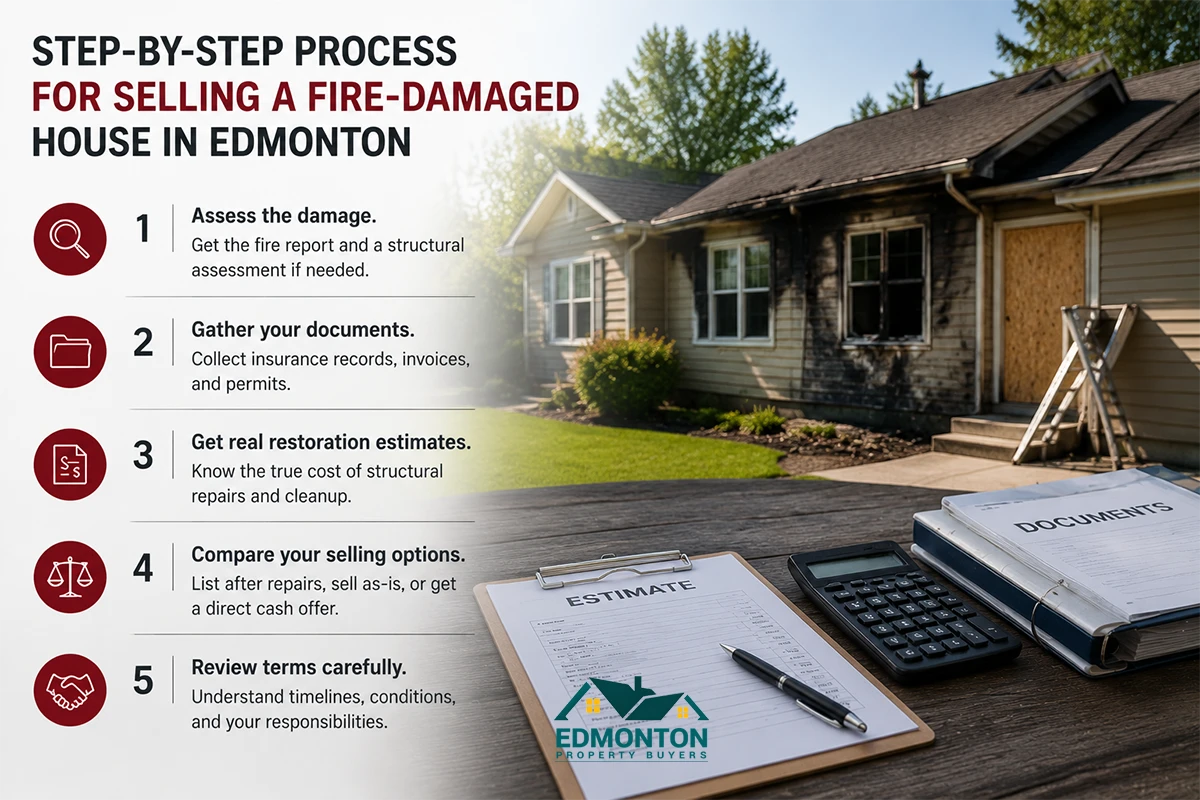
Step-by-Step Process for Selling a Fire-Damaged House in Edmonton
However you decide to sell, the process generally moves through the same five stages, though how long each one takes depends heavily on your specific damage.
- Assess the damage properly before deciding anything. Request your fire investigation report from the City and get a professional structural read if there’s any chance the framing was compromised. Guessing at the scope here is what leads to underestimated repair costs later.
- Gather your documentation as you go, not after the fact. Insurance correspondence, contractor invoices, and permits for any reconnected utilities all get harder to track down once the immediate crisis has passed and everyone involved has moved on to other work.
- Get real restoration estimates, not rough guesses. Structural rebuilding and smoke/soot remediation are very different financial commitments, and the gap between what you assume repairs will cost and what a contractor actually quotes is often where homeowners get caught off guard.
- Compare your selling paths against your actual numbers. Weigh a traditional listing after restoration against selling as-is or working with a direct buyer, using the real repair estimate from the step above rather than a rough guess.
- Review terms carefully before committing to any path. Whether you’re signing a listing agreement or accepting a direct offer, understand the timeline, conditions, and responsibilities before you move forward, not after.
Common Mistakes to Avoid When Selling a Fire-Damaged House
A few mistakes come up often enough with fire-damaged properties that they’re worth naming directly before you’re further into the process.
- Starting expensive restoration before checking whether it’ll actually add to your sale price. A full structural rebuild can cost more than it recovers at sale, particularly in a neighborhood where comparable homes aren’t selling for much more than what the repaired property would be worth.
- Underestimating how long permits and inspections can add to a repair timeline. Reconnecting utilities damaged by a fire requires permitted, inspected work, and that process can stretch a project well past what the contractor originally quoted, especially if multiple systems were affected.
- Letting documentation slide once the immediate crisis feels resolved. It’s easy to stop keeping records once you’re no longer living out of a hotel, but buyers and their inspectors will still want to see the paper trail months later, and it’s much harder to reconstruct than to keep as you go.
- Disclosing what’s been fixed but not what’s still unresolved. A partial disclosure that lists completed repairs while leaving out an unpermitted or incomplete one tends to create more suspicion, and more risk, than being upfront about the full picture from the start.
None of these take much extra effort to avoid, they just require treating the sale with the same care you already gave the recovery itself.
When Does Selling a Fire-Damaged House Directly Make Sense?
A direct sale tends to make sense when the restoration estimate is high relative to what it would add to your sale price, when you’re not in a position to manage a lengthy repair-and-permit process, or when you’d simply rather not take on a project of that scale while you’re already dealing with displacement and insurance. It’s also worth considering if you’re genuinely unsure which path fits and want a straightforward way to find out without committing to restoration first.
None of that makes it automatically the right call for every situation, it’s one option among a few worth weighing against your specific damage and circumstances.
Talk to Someone About Your Fire-Damaged Property
If you’re trying to figure out what a fire-damaged property is actually worth or which path makes sense, a conversation is usually faster than researching alone. Edmonton Property Buyers can review your situation, no restoration required, no pressure either way. Reach out at +1 (587) 855-5427 or [email protected] whenever you’re ready.
The Final Word
A house fire changes what selling looks like, but it doesn’t take selling off the table. If you need to sell a house after fire damage, understanding the severity, restoration status, documentation, and property’s current value can make the decision much clearer. Once you know where your damage actually falls on the severity range, what your insurance and restoration situation looks like, and what documentation you have to back it up, the decision between restoring, selling as-is, or working with a direct buyer becomes much more concrete than it probably feels right now.
There’s no single right path for every fire-damaged property. What matters is choosing based on your actual situation, not the version of the decision you’re imagining right now. If you want a clearer picture of where your property stands, Edmonton Property Buyers can walk through it with you directly.
Frequently Asked Questions
References
- Real Estate Council of Alberta (RECA), Real Estate Act Rules –https://www.reca.ca/rules/
- RECA (Consumer Hub), “Property Considerations: Material Latent Defects” – https://www.recaprotects.ca/property-considerations/#Material-Latent-Defects
- Appraisal Institute of Canada, “Real Estate Damages: The Appraisal of Properties Impacted by Detrimental Conditions” – https://www.aicanada.ca/article/real-estate-damages-the-appraisal-of-properties-impacted-by-detrimental-conditions/
- City of Edmonton, “Fire Recovery” – https://www.edmonton.ca/residential_neighbourhoods/fire_safety/after-the-fire
- City of Edmonton, “Fire Report Request” – https://www.edmonton.ca/programs_services/fire_rescue/fire-report-request