
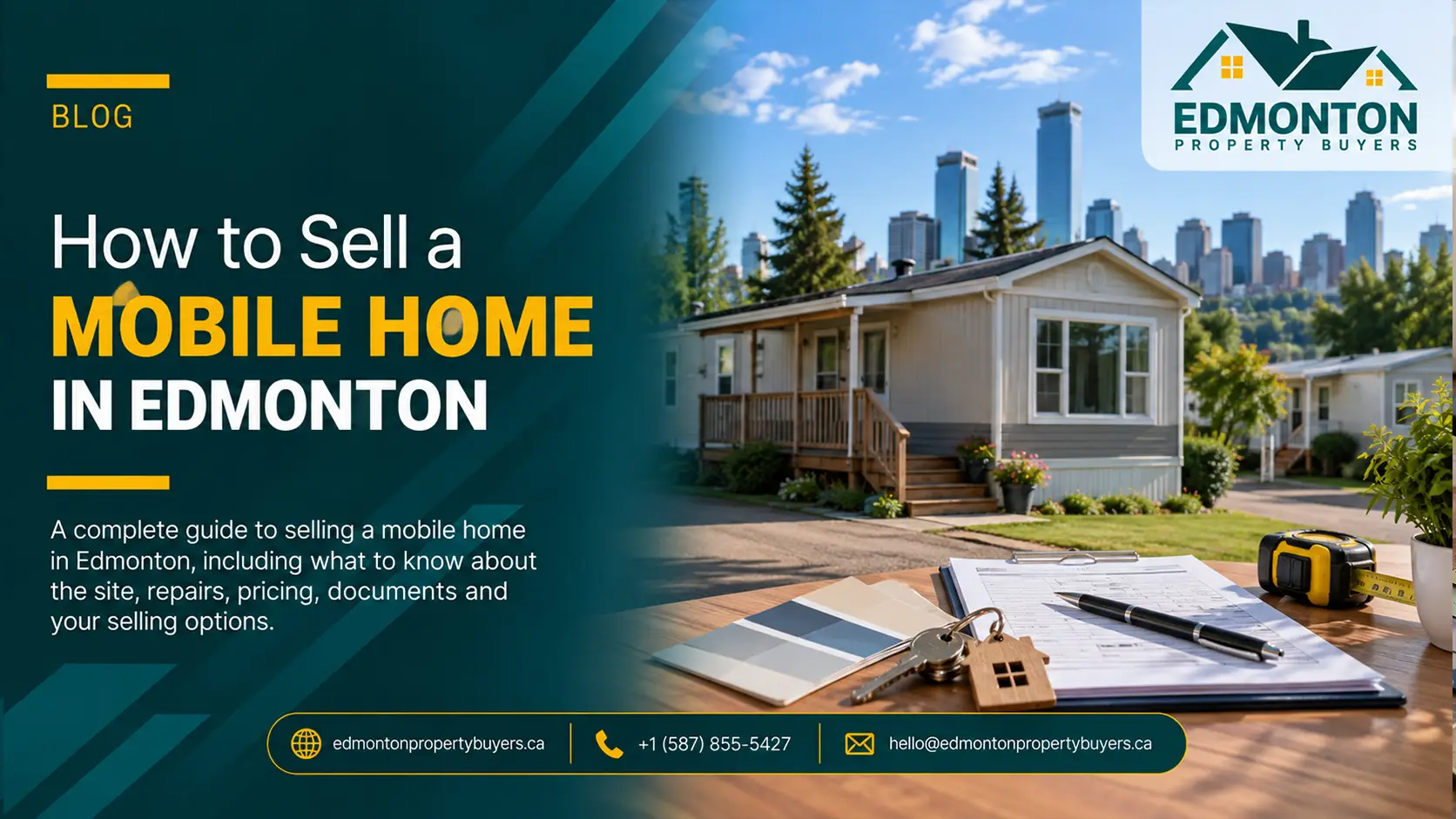
Selling a mobile home in Edmonton can involve more moving parts than selling a conventional house. If you’re considering selling your home in Edmonton, the process may depend on the home’s condition, location, community rules, and whether the land is included.
One of the first things to clarify is what you actually own. You may own the home and land, own only the home while renting the site, or live in a mobile home community where site fees and community requirements apply. This arrangement can affect the documents, buyer pool, and sale process.
From there, you’ll need to consider the home’s condition, pricing, preparation, documents, and selling method. This guide explains those steps and the available selling options so you can choose an approach that fits your situation.
Thinking About Selling Your Edmonton Home?
Whether your home needs repairs, you're facing a life change, or you simply want a faster, simpler sale, Edmonton Property Buyers can help you explore your options.
simpler way
forward.

Local people.
Can You Sell a Mobile Home in Edmonton?
Yes, mobile homes can be sold in Edmonton, but the process depends heavily on what the seller actually owns and how the home is situated.
What Counts as a Mobile or Manufactured Home, and Do You Own the Land?
In everyday conversation, “mobile home” and “manufactured home” are often used interchangeably, although Alberta legislation distinguishes between the two. For a sale, the more important question isn’t the terminology, it’s ownership.
A seller might own the mobile home and the land underneath it, own only the home while renting the site it sits on, or own the home in a mobile home community where site rent and community rules apply. Each arrangement affects documentation, the buyer pool, financing, and how the sale actually closes.
Selling a Home in a Mobile Home Community, and How This Differs From a House Sale
Homes located in a mobile home community, sometimes called a mobile home park, can absolutely be sold, but the sale typically involves more than transferring the home itself. A buyer usually needs to be accepted by the community or approved to take over the site tenancy, which adds a step that a conventional house sale doesn’t have.
That’s the core difference: a house sale is centered on the property and the land title, while a mobile home sale often separates the home from the land, which changes how ownership is documented, how the sale is financed, and who else needs to be involved, such as a site landlord or community manager.

What Should You Know Before Selling a Mobile Home in Edmonton?
Before pricing or preparing the home, a few property-specific factors are worth understanding first. Whether you own the land, rent the site, or live in a managed community changes what you’re actually selling and what a buyer needs to do to take possession, and it’s the starting point for every other decision in the sale. Age and condition affect both value and buyer interest, the same way they would with a house, and monthly site fees, sometimes called lot rent, are part of the real cost of ownership a buyer will weigh.
Mobile home communities often have rules covering pets, age restrictions, home appearance, or resident approval, and these can affect who’s eligible to buy. Combined with financing that can be more limited than for conventional homes, this often means a smaller and more specific buyer pool than a house in the same price range would attract.
How Does the Mobile Home Site Affect the Sale?
For many Edmonton mobile home sellers, the site arrangement is one of the biggest differences from a typical house sale, and it deserves its own close look.
What Happens If You Rent the Land?
In Alberta, the Mobile Home Sites Tenancies Act (MHSTA) applies specifically to people who own a mobile home and rent the parcel of land it sits on. It’s a different law from the Residential Tenancies Act, which applies if someone rents the mobile home itself rather than owning it.
The MHSTA itself doesn’t govern the sale of the mobile home, but it governs the tenancy that comes with it when the land is rented, which is why notice periods, fee increases, and ending a tenancy all fall under its rules rather than a standard rental agreement. The exact requirements can depend on the site agreement and the community involved, so it’s worth confirming the applicable rules with the landlord or a lawyer before completing a sale.
What Should You Check in the Site Agreement?
The site tenancy agreement typically outlines the rent, any fees or assessments beyond rent, and the community’s rules. Under Alberta’s rules, a landlord must disclose all fees and charges and the existing site rules in writing before the tenancy begins, and fee increases generally require 180 days’ notice in a mobile home community and 90 days’ notice for sites outside a mobile home community. Reviewing this agreement early tells a seller exactly what a buyer will be taking on.
Can a Buyer Take Over the Mobile Home Site?
Often, yes, but it usually isn’t automatic. Under the MHSTA, a tenant can’t assign or sublease their site to someone else without the landlord’s written consent, though a landlord can’t refuse without reasonable grounds and generally must respond within 15 days. Buyers may also need to meet the community’s own approval requirements, separate from the landlord’s consent to the assignment. Confirming this process early avoids surprises once an offer is on the table.
Should You Prepare or Repair a Mobile Home Before Selling?
Not every mobile home needs major work before listing, and the right level of preparation depends on the home’s condition and what buyers in the price range typically expect. Deep cleaning, decluttering, and tidying up the exterior and entry are inexpensive steps that make a real difference in how a home shows, whether the home is occupied, vacant, or being sold after a tenant has moved out.
Minor Repairs Worth Doing vs. Major Renovations
Fixing obvious maintenance issues like leaky faucets, damaged skirting, or a sticking door is usually worth the modest cost involved. Bigger decisions, like plumbing or electrical problems, a roof in poor condition, or renovating a kitchen, deserve more scrutiny, since age and condition can affect how much of that cost is actually recovered at resale. Comparing what similar renovated and unrenovated homes have actually sold for in the same community is a more reliable guide than assuming a repair will pay for itself.
When Renovating May Not Make Financial Sense
A major renovation doesn’t always pay for itself, particularly in a market segment where buyers are pricing based on comparable mobile homes rather than expecting high-end finishes. Before committing to significant work, it’s worth comparing what similar homes, renovated and unrenovated, have actually sold for, and asking whether the repair removes a genuine buyer objection or is more of a personal preference.

How Much Is a Mobile Home Worth in Edmonton?
Mobile home pricing can’t simply borrow from what nearby detached houses are selling for. It requires a different set of comparisons.
What Factors Affect Mobile Home Value?
Value is shaped by whether the land is owned or rented, the home’s age and condition, its size, any upgrades, and its location or community. Age doesn’t automatically mean a mobile home depreciates. Location, upgrades, and buyer demand can offset the effect of age just as they would for a house. Owning the underlying land generally adds real property value that a rented site arrangement doesn’t carry in the same way, since the buyer is only purchasing the home itself in that scenario.
Pricing It Right: Comparables, Site Fees, and the Cost of Overpricing
The most useful comparisons are other mobile homes that have recently sold in the same or a similar community, with a similar age, size, and condition. Generic Edmonton housing averages aren’t built for this kind of comparison and can be misleading if used on their own.
An owner who wants to sell mobile home Edmonton wide should also factor in site fees, since buyers mentally add monthly fees to the purchase price when judging affordability, so two homes at the same asking price with different site fees aren’t really priced the same from a buyer’s perspective. An overpriced home tends to sit, and the longer it sits, the more buyers may assume something is wrong with it, which often results in a lower final sale price than if it had been priced accurately from the start.
How Should You Market a Mobile Home for Sale?
Once pricing and condition are sorted out, presenting the home clearly to the right buyers becomes the next priority. A strong listing spells out whether the land is included, the site fee amount, the home’s age and size, and any community rules a buyer should know about upfront, and professional photography tends to be worth the cost since it’s often the first impression a buyer forms before ever requesting a showing.
Curb appeal matters as much for a mobile home as it does for a house, and a clean, tidy exterior and entry can meaningfully shift a buyer’s first impression. If the community has genuine draws, like a playground, proximity to transit, or a quiet, well-maintained setting, those are worth mentioning too. Being upfront about site fees and what they include builds trust rather than creating a surprise later in the process, and it helps to have the home consistently ready for showings, since buyers evaluating a smaller pool of available homes may want to see a property quickly once they’re interested.
What Can Make a Mobile Home Harder to Sell?
A handful of recurring issues tend to slow down or complicate a mobile home sale:
- An unrealistic asking price that doesn’t reflect comparable mobile home sales
- Significant deferred maintenance that buyers notice or that surfaces during an inspection
- High site fees relative to similar homes in the area, without a clear explanation
- Restrictive community rules that narrow the pool of eligible buyers
- Limited financing options, since buyer financing for mobile homes can be more restrictive than conventional mortgages, especially when the land isn’t included
- Poor presentation, including clutter or an unclean exterior
- Competing mobile homes for sale in the same community at the same time
What Are Your Options for Selling a Mobile Home in Edmonton?
There’s no single correct way to sell a mobile home. The right choice depends on the seller’s timeline, how much preparation they’re willing to do, and how they weigh certainty against maximum exposure.
A traditional listing through a Realtor typically offers wider buyer exposure and professional marketing, in exchange for commission and the preparation and showings that come with a public listing. A private sale gives the seller more control over pricing and negotiation, along with the added responsibility of marketing, screening buyers, and coordinating paperwork. A direct sale with cash for mobile home in Edmonton usually involves a simpler process with fewer preparation requirements, though the offer still needs to be evaluated against expected proceeds from other selling methods, not accepted on convenience alone. Lining these routes up against the same criteria makes the trade-offs easier to weigh than considering them one at a time.
| What to Compare | Realtor Listing | Private Sale | Direct Sale |
|---|---|---|---|
| Buyer exposure | Widest, via MLS and marketing | Limited to owner's reach | Single buyer, no public listing |
| Preparation required | Usually more prep for showings | Owner's choice | Minimal to none |
| Selling costs | Commission and closing costs | Marketing and legal costs | May involve lower selling costs, depending on the transaction |
| Time to offer | Depends on market conditions | Depends on owner's reach | Can be faster |
| Seller effort | Moderate to high | High | Low |
Can You Sell a Mobile Home As-Is?
Yes, selling as-is is a common route, particularly for an older home or one that needs work the seller doesn’t want to take on. Selling as-is doesn’t remove the general expectation that sellers disclose known issues that could affect a buyer’s decision, and the site agreement and community documentation are still typically needed regardless of the home’s condition. Before accepting an as-is offer, it’s worth comparing it against what the home might net after modest repairs and a traditional listing, since the difference isn’t always as large as it first appears.
What Documents Do You Need to Sell a Mobile Home?
Documentation for a mobile home sale often looks different from a house sale, since the home itself and the land aren’t necessarily governed by the same registry.
1.Proof of Ownership and the Personal Property Registry
When a mobile home isn’t affixed to owned land, it’s generally handled as personal property, and interests in it can be searched by serial number through Alberta’s Personal Property Registry rather than through Land Titles. Sellers should confirm how their home is registered and be ready to show proof of ownership, such as a bill of sale, and confirm there are no liens registered against it. If the home and land are both owned, the land title itself becomes part of the transaction instead.
2.Site Agreement and Outstanding Amounts
For a home on a rented site, the current tenancy agreement, the fee schedule, and any community rules are documents a buyer or their lawyer will likely want to review before completing a purchase. It’s also worth confirming whether site fees, assessments, or a mortgage or loan on the home itself are fully paid, or what remains owing, since this helps avoid delays once an offer is accepted and prevents any surprises for the buyer at closing.
How Do You Get Started If You Need to Sell Your Mobile Home Quickly?
Start by confirming exactly what you own, the home alone, the home and the land, or the home on a rented site, since that shapes everything that follows. Anyone looking to sell mobile home Edmonton quickly should assess the home’s condition honestly, gather the site agreement and any ownership documents, and understand selling costs and what’s still owed before deciding how much preparation is worth doing.
With that groundwork in place, comparing traditional, private, and direct-sale options side by side, using the table above as a starting point, becomes a much more straightforward decision.
What Should You Check Before Accepting an Offer?
Checklists are always useful for big moves like selling a house or a condo in Edmonton. An offer is more than a single number, and a few details are worth reviewing closely before signing:
- Purchase price relative to comparable mobile home sales
- Closing and possession date, and whether it fits your timeline
- Conditions attached to the offer, such as financing, inspection, or landlord approval of the site transfer
- Selling costs and expected net proceeds, after commission, legal fees, and any payout owing
- Site fees or amounts owing, and how they’ll be handled at closing
- Buyer and transaction certainty, including whether financing and next steps are clearly defined
Common Mistakes to Avoid When Selling a Mobile Home in Edmonton
A few mistakes show up often enough in mobile home sales to call out directly:
- Pricing it like a conventional house instead of using comparable mobile home sales
- Ignoring the site arrangement until a buyer asks questions the seller can’t answer
- Spending too much on renovations without checking whether similar homes actually sell for more
- Hiding or ignoring known problems rather than disclosing them upfront
- Waiting too long to organize documents, including the site agreement and proof of ownership
- Ignoring community rules or site requirements that could disqualify an otherwise interested buyer
- Focusing only on the offer price instead of net proceeds, terms, and timeline together
- Choosing a selling method without considering the timeline that actually matters most

Edmonton Property Buyers: A Local Option for Mobile Home Sellers
Edmonton Property Buyers is a local direct cash home buyer serving Edmonton and surrounding communities since 2018. We buy mobile homes in Edmonton, whether the land is owned or the home sits on a rented site. For a seller who wants a simpler process without preparing the home for a traditional listing, this can be worth comparing alongside other options. Reach the team directly at +1 (587) 855-5427 or hello@edmontonpropertybuyers.ca to discuss a specific situation with no obligation to accept an offer.
Have Questions About Your Selling Situation?
Homeowners can talk through their property, their timeline, its condition, and any concerns, without any commitment attached to the conversation itself.
A simple conversation can help you understand your options.
Final Thoughts
Selling a mobile home successfully starts with a different question than selling a house does: what exactly do you own, and how is the site arranged? Once that’s clear, accurately assessing the home’s condition and value against real comparables matters more than following generic staging advice.
Preparation is worth doing where it removes a genuine buyer objection, not as a default. Comparing selling methods based on net proceeds, effort, timing, and certainty, rather than headline price alone, tends to lead to a better outcome. The right strategy ultimately depends on the property and the seller’s own priorities.
References
- Government of Alberta, “Renting a Mobile Home Site”
- Government of Alberta, “Personal property liens: Find a registration”
- Government of Alberta, “Land Titles – Overview”
- City of Edmonton, “Assessment Reference Materials”
- Real Estate Council of Alberta (RECA), Consumers