
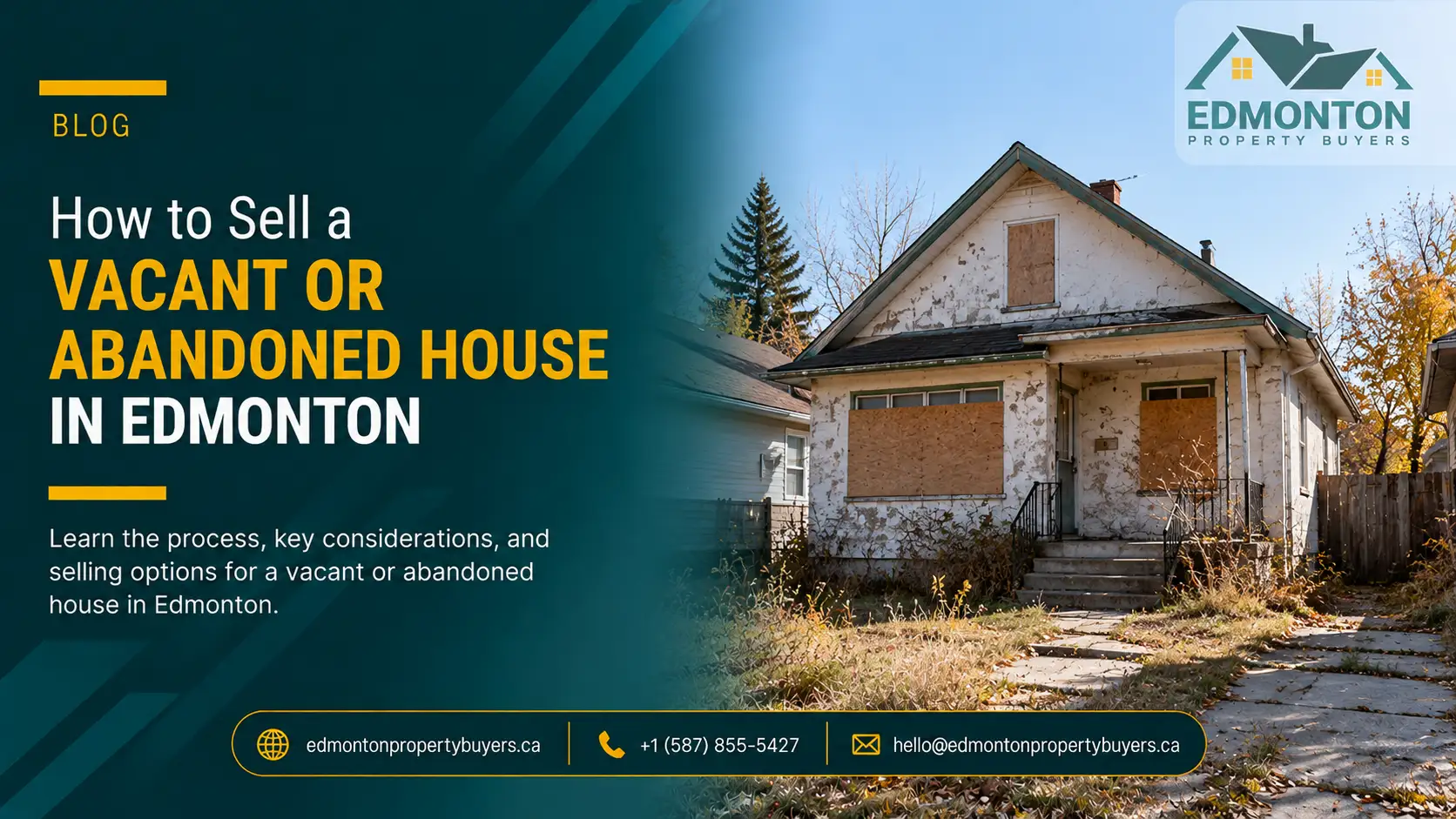
An empty house doesn’t stop being an asset simply because nobody is living in it, but vacancy can create a different set of selling challenges. The longer a property sits empty, the more you may have to think about maintenance, security, utilities, condition, and carrying costs. You’ll also need to decide whether preparing the house is worth the cost or whether selling it in its current condition makes more sense. This guide covers how to sell a vacant house in Edmonton, including one that looks abandoned, by walking through how to assess it, prepare it, price it, and choose a selling method.
Thinking About Selling Your Edmonton Home?
Whether your home needs repairs, you're facing a life change, or you simply want a faster, simpler sale, Edmonton Property Buyers can help you explore your options.
simpler way
forward.

Local people.
Can You Sell a Vacant or Abandoned House in Edmonton?
Yes, a vacant house can be sold in Edmonton, whether you choose a traditional listing, a private sale, or a direct buyer, but its condition, security, maintenance, and selling strategy all need to be considered. Vacancy by itself doesn’t prevent a sale. A vacant house is also still part of the broader Edmonton housing market, so many of the same fundamentals apply when you’re ready to sell your house in Edmonton.
What's the Difference Between a Vacant House and an Abandoned One?
A vacant house is simply unoccupied. The owner may have moved, the property may be between tenants, or it may have been inherited or be waiting for a sale, and none of that says the house is in poor shape. An abandoned-looking house is usually a vacant house that has also gone without regular care, with signs like deferred maintenance, an overgrown yard, debris, security concerns, moisture issues, or vandalism. “Abandoned” describes a property’s condition, not a legal status, and that condition shapes almost every decision that follows, from repairs to pricing to the selling method.
Why Do Homeowners End Up With a Vacant House?
A house usually becomes vacant for a reason, and that reason can influence which selling strategy fits best. Common scenarios include:
- Relocation: the owner moved and hasn’t sold yet
- Inheritance: the new owner doesn’t plan to live there
- Downsizing: the owner moved to a smaller home
- A former rental: a tenant moved out
- Divorce or separation: neither person wants to keep the home
- Financial difficulty: the owner can no longer keep up the property
- Major repairs: the work stalled or never finished
- An investment purchase: the property sat unused
- Long-term neglect: the house has gone unattended for years
What Should You Check Before Selling a Vacant House?
Knowing how to sell a vacant house in Edmonton starts with knowing what condition the property is actually in. Walk the exterior and check the roof, windows, doors, and yard, then see whether the plumbing, heating, and electrical systems work and whether there’s any sign of water or moisture, especially in the basement. Note structural concerns, pests, and the state of the floors and appliances, and check security: whether doors and windows lock, whether there’s been vandalism, and whether snow or ice has built up around entrances. Photos and notes give you something concrete to price from.
It helps to sort the house into one of four condition levels. Good condition means it’s mostly maintained and needs limited preparation. Needing cosmetic work means cleaning, paint, flooring, and minor presentation issues. Needing repairs means deferred maintenance or functional problems. Major damage or distress means significant water, structural, fire, mold, or other problems, which usually calls for a specialized assessment first.

How Should You Protect a Vacant House While It's for Sale?
Protecting an empty house is mostly about catching small problems before they become expensive ones, especially through an Edmonton winter. A practical routine includes:
- Insurance: keep coverage active and ask your insurer what it requires once a home is vacant
- Regular inspections: have someone check the house on a set schedule
- Heat and plumbing: keep the heat high enough to protect the pipes, and watch for leaks
- Security: keep doors and windows secured and watch for vandalism
- Mail and exterior: collect mail, keep up the yard, and arrange snow removal in winter
Insurance deserves a call before anything else. Many policies limit or change coverage once a home has been vacant for a set period, but the details differ, so tell your insurer the house is empty and ask what your policy requires. Snow removal matters in Edmonton too: the City’s Community Standards Bylaw requires you to keep any sidewalk next to your property clear of snow and ice, and when that isn’t done, the City can issue a $100 ticket and invoice you for the clearing.
Should You Repair a Vacant House Before Selling?
Vacancy doesn’t mean renovation is necessary. The better question is whether each repair is likely to change what buyers will pay, or whether they’ll consider the house at all. A simple way to sort the decision is by the type of problem:
| Situation | Potential Approach |
|---|---|
| Minor maintenance | Address obvious issues |
| Cosmetic problems | Compare the cost against the expected benefit |
| Functional problems | Evaluate the effect on buyer interest |
| Major repairs | Compare the repair investment with an as-is sale |
| Significant damage | Consider a specialized assessment |
Safety fixes, active leaks, and obvious objections are often worth addressing, and serious water, flood, structural, or fire damage deserves a specialized assessment first, while expensive cosmetic upgrades and projects with an uncertain return are harder to justify when carrying costs keep running. What’s actually worth doing comes down to the likely benefit against the cost and the extra carrying time, and when the repair bill is large, selling as-is can become a reasonable option, covered below.
How Should You Clean and Prepare an Abandoned House?
Cleaning is different from renovating. The goal is to make the house safe, accessible, and presentable enough to judge fairly. Outside means clearing debris, cutting back the yard, and dealing with snow. Inside means removing trash and leftover belongings, tackling odors, and basic cleaning. Safety items include exposed wiring, broken glass, and blocked access, and utilities like heat, water, and electricity should be working where possible so buyers and inspectors can see how the house functions.
Does an Abandoned House Need to Be Completely Clean Before Selling?
Not necessarily. A house doesn’t have to look staged to sell, and some buyers want a property they can clean up and renovate themselves. But removing trash, standing water, and obvious hazards matters in almost any sale, because those things affect safety, first impressions, and how much work a buyer assumes the house needs. A cleaner house is also easier to photograph, inspect, and price accurately.
Should You Remove Everything, and When Is a Professional Cleanout Worth Considering?
If the belongings are yours, you decide what stays, goes, or gets sold or donated, and clearing out personal items usually makes the house easier to show and price. Some buyers will take a property with contents left in place, but that should be agreed in writing. A professional cleanout is worth considering when there’s a large volume of belongings, unsanitary conditions, or more sorting than you can manage on your own.
How Much Is a Vacant House in Edmonton Worth?
Vacancy by itself isn’t the main factor in a house’s value. Location, property type, size, lot, current condition, comparable properties, required repairs, renovation potential, market conditions, and the likely buyer pool all matter more.
Does a vacant house sell for less? It doesn’t have to. A well-kept vacant house in a sought-after location may sell much like an occupied one, while a neglected house priced as if it were maintained tends to sit.
How do repairs affect value? Repairs can improve value, but the gain doesn’t always match the cost, so compare recent sales of similar properties in similar condition before assuming a repair will pay for itself.
Should you price from the after-renovation value? Generally not. Pricing on what the house might be worth after a full renovation, on a renovated house nearby, or on what you originally paid overlooks the cost, time, and risk a buyer takes on. If you want to sell vacant house Edmonton buyers will pay fair value for, price from the house’s current condition and comparable properties.
What Are Your Options for Selling a Vacant House in Edmonton?
There are four realistic paths, and none is the best. The right one depends on condition, repair costs, time, and how much of the process you want to manage yourself.
Sell through a Realtor. A traditional listing offers broad exposure and professional marketing, in exchange for commission, preparation, showings, and negotiation.
Sell privately. You keep control and talk directly with buyers, but you handle the marketing, screening, negotiation, and paperwork yourself.
Sell directly to a buyer. A direct sale can suit owners who want to sell vacant house Edmonton buyers will take as-is, without extensive preparation or showings, though the offer and terms still need careful comparison.
Keep holding the property. Holding means carrying taxes, insurance, utilities, maintenance, and security, so it helps to have a clear reason and timeline.
Here’s how the two most common routes compare on the factors that usually matter most:
| Factor | Traditional Sale | Direct Sale |
|---|---|---|
| Preparation | Often greater | May be less |
| Marketing | Broader | More direct |
| Showings | Typically part of the process | May be reduced |
| Buyer pool | Broad | More specific |
| Selling costs | May include agent commission | Structure varies |
| Timeline | Market-dependent | Negotiated |
| Property condition | Presentation matters | As-is may be possible |
| Seller effort | Often higher | Potentially lower |
Neither column wins on every row. Comparing a cash buyer vs. a Realtor in Edmonton in more detail can help if those are the two routes you’re weighing.
Is Selling a Vacant House As-Is a Good Option?
Selling as-is means you sell the house in its current condition without making repairs first, and the price reflects that. It may be worth considering when major repairs are required, you don’t want to renovate, the house has been vacant a long time, carrying costs are becoming burdensome, or you want a simpler process. Think twice when the house only needs inexpensive preparation, repairs could meaningfully improve its marketability, or you have plenty of time.
Does As-Is Mean You Don't Have to Disclose Known Problems?
No. Selling as-is describes the condition you’re selling in, not permission to hide what you know. The Real Estate Council of Alberta explains that a material latent defect is a physical issue that makes a property dangerous or unsafe to live in, makes it unfit for its intended purpose if the seller knows that purpose, or would be very costly to repair, and that can’t be seen through a regular inspection. A seller who knows about one generally has to disclose it, whether or not a Realtor is involved. If you’re working with a real estate licensee, tell them what you know too, since they have disclosure obligations of their own, and you can’t hide or misrepresent the property’s condition. If you’re unsure what applies, talk to a lawyer.
What Can Make a Vacant House Harder to Sell?
These issues tend to slow a vacant house down the most, and buyers can often spot most of them before they ever make an offer:
- Significant deferred maintenance, which raises the discount buyers expect
- Security concerns, such as broken locks or signs of a break-in
- Poor exterior condition, which shapes the first impression
- Water or moisture problems, which raise questions about hidden damage
- Unrealistic pricing, which keeps a house on the market while costs build
- Limited buyer appeal, when condition or layout narrows the pool
- High carrying costs, which pressure the seller to decide quickly
- Lack of preparation, even basic cleaning and safety work

What Should You Look for When Choosing a Buyer for a Vacant House?
A vacant property can attract renovators, investors, and owner-occupiers who are comfortable taking on work, and each will look at the house differently. What matters most is understanding exactly what they’re offering.
What Should You Ask a Buyer, and Why Compare the Whole Offer?
Start with the basics: Is the offer clear and in writing? What are the purchase terms, closing date, and possession date? Is there a deposit, and what conditions are attached? Ask for proof of funds or financing where relevant, and find out who pays which costs and whether the contract can be canceled or assigned. A headline number says little about what you’ll actually receive, because two offers at the same price can leave you with very different net proceeds once you account for selling costs, repairs, conditions that could let the buyer walk away, and how long you’ll keep paying carrying costs. A slightly lower offer with clean terms can beat a higher one that puts the sale at risk.
What Costs Should You Consider When Selling a Vacant House?
A vacant house keeps costing money while it waits, so count both what it takes to prepare it and what it takes to hold it:
- Carrying costs: property taxes, insurance, utilities, heating, security, and snow and yard maintenance
- Preparation costs: repairs, cleaning, and staging if you choose it
- Transaction costs: Realtor commission, legal fees, and any mortgage payout or discharge costs
The Financial Consumer Agency of Canada lists legal fees, realtor commission, mortgage discharge fees, and possible prepayment penalties among the standard costs of selling a home. Carrying costs matter more the longer the house sits empty, because they keep adding up whether or not it’s moving.
How Can You Get Started If Your Edmonton House Has Been Sitting Vacant?
Anyone working out how to sell a vacant house in Edmonton can start by visiting the property and documenting its condition with photos and notes. Then secure it and review your insurance and carrying costs, estimate what preparation it needs, and work out a realistic value from its current condition and comparable properties. With those numbers in hand, compare selling methods against your priorities, whether that’s price, speed, effort, or certainty.
Common Mistakes to Avoid When Selling a Vacant or Abandoned House
Most of these come from treating a vacant house as if it can look after itself, or from deciding on a price or a strategy before knowing the house’s real condition:
- Leaving the property unchecked, which lets small problems turn expensive
- Letting insurance lapse without understanding the policy, which can leave you exposed
- Spending heavily on renovations without calculating the return, when buyers may not pay back the cost
- Pricing based on the property’s potential, rather than its current condition
- Ignoring security, which invites vandalism
- Assuming vacant means as-is, when disclosure responsibilities still apply to known problems
- Focusing only on the offer price, instead of net proceeds, terms, and timeline
- Waiting too long while carrying costs accumulate, which erodes what the sale nets
Edmonton Property Buyers as a Direct Option for Vacant Houses
Edmonton Property Buyers is a local direct cash home buyer serving Edmonton and surrounding communities since 2018. The company has purchased more than 170 homes since 2018, typically responds within 3 hours, provides an offer within 48 hours, and closes in an average of 14 days at 100% of the agreed amount. We buy vacant houses in Edmonton, whether the house is simply empty or has been neglected for some time. For an owner who wants to sell vacant house Edmonton investors are interested in without preparing it for a traditional listing, a direct sale is one option worth comparing on price, timing, effort, and certainty. Reach the team directly at +1 (587) 855-5427 or hello@edmontonpropertybuyers.ca, with no obligation to accept an offer.
Have Questions About Your Selling Situation?
Homeowners can talk through their property, their timeline, its condition, and any concerns, without any commitment attached to the conversation itself.
A simple conversation can help you understand your options.
Final Thoughts
A vacant house isn’t automatically a distressed property, but leaving it empty creates additional maintenance, security, and carrying-cost considerations. Vacancy itself doesn’t determine a house’s value; its condition and ongoing costs matter far more. Before selling, it helps to understand the property’s actual condition, decide how much preparation is genuinely worthwhile, and compare selling methods on the overall outcome rather than the headline price. For some houses a traditional sale makes sense, and for others selling in the current condition is more practical, so the right strategy depends on the property and the owner’s circumstances.
References
- City of Edmonton, “Residential Sidewalk Snow and Ice” https://www.edmonton.ca/transportation/on_your_streets/sidewalk-snow-removal
- City of Edmonton, “Community Standards Bylaw 14600” https://www.edmonton.ca/public-files/assets/document?path=bylaws/c14600.pdf
- Real Estate Council of Alberta (RECA), “Property Considerations” https://www.recaprotects.ca/property-considerations/
- Government of Alberta, “Common problems for landlords and tenants” https://www.alberta.ca/common-problems-landlords-and-tenants
- Financial Consumer Agency of Canada, “Selling a Home” https://www.canada.ca/en/financial-consumer-agency/services/selling-home.html